<?xml version="1.0" encoding="utf-8"?>
<feed xmlns="http://www.w3.org/2005/Atom">
    <id>https://docs.kazinex.com/blog</id>
    <title>Kazinex Docs Blog</title>
    <updated>2026-07-02T00:00:00.000Z</updated>
    <generator>https://github.com/jpmonette/feed</generator>
    <link rel="alternate" href="https://docs.kazinex.com/blog"/>
    <subtitle>Kazinex Docs Blog</subtitle>
    <icon>https://docs.kazinex.com/img/favicon.ico</icon>
    <entry>
        <title type="html"><![CDATA[An Aconex Alternative That Keeps Your Documents in Your Own SharePoint]]></title>
        <id>https://docs.kazinex.com/blog/aconex-alternative-document-control</id>
        <link href="https://docs.kazinex.com/blog/aconex-alternative-document-control"/>
        <updated>2026-07-02T00:00:00.000Z</updated>
        <summary type="html"><![CDATA[Oracle Aconex is the default for construction document control — but it's enterprise-priced and it holds your documents. Here's how Kazinex Workflows compares, with your files staying in your own SharePoint.]]></summary>
        <content type="html"><![CDATA[<p>If you run correspondence, transmittals, and submittals on a construction or EPC project, you've almost certainly used — or been told to use — <strong>Oracle Aconex</strong>. It's capable and widely mandated. But two things push teams to look for an alternative: the <strong>enterprise price tag</strong>, and the fact that <strong>your project's documents live in Oracle's cloud</strong>, not yours.</p>
<h2 class="anchor anchorTargetStickyNavbar_Vzrq" id="the-two-real-objections-to-aconex">The two real objections to Aconex<a href="https://docs.kazinex.com/blog/aconex-alternative-document-control#the-two-real-objections-to-aconex" class="hash-link" aria-label="Direct link to The two real objections to Aconex" title="Direct link to The two real objections to Aconex" translate="no">​</a></h2>
<p><strong>Cost.</strong> Aconex is priced and sold as an enterprise platform — typically a per-project or per-portfolio commitment negotiated through sales. For a mid-size contractor, a consultancy, or a single project that just needs disciplined document control, that's a heavy lift.</p>
<p><strong>Data custody.</strong> On Aconex, correspondence and documents are held in Oracle's system. Getting a clean, complete export at project close — or mid-dispute — is its own exercise. Many organizations' IT and legal teams increasingly want project records to stay inside infrastructure they control.</p>
<h2 class="anchor anchorTargetStickyNavbar_Vzrq" id="how-kazinex-workflows-approaches-it-differently">How Kazinex Workflows approaches it differently<a href="https://docs.kazinex.com/blog/aconex-alternative-document-control#how-kazinex-workflows-approaches-it-differently" class="hash-link" aria-label="Direct link to How Kazinex Workflows approaches it differently" title="Direct link to How Kazinex Workflows approaches it differently" translate="no">​</a></h2>
<p><strong>Kazinex Workflows</strong> does the core document-control job — a configurable workflow engine (review / approve / acknowledge / sign steps), correspondence, transmittals, templates, and deadline reminders — but with a different data model:</p>
<table><thead><tr><th></th><th>Oracle Aconex</th><th>Kazinex Workflows</th></tr></thead><tbody><tr><td>Correspondence + transmittals</td><td>✅</td><td>✅</td></tr><tr><td>Configurable multi-step workflows</td><td>✅</td><td>✅</td></tr><tr><td>Deadline reminders / daily digest</td><td>✅</td><td>✅</td></tr><tr><td>Document storage</td><td>Oracle's cloud</td><td><strong>Your own SharePoint</strong></td></tr><tr><td>Pricing</td><td>Enterprise quote</td><td>Accessible, per-team</td></tr><tr><td>External sharing</td><td>✅</td><td>✅ (tokenized guest links)</td></tr></tbody></table>
<p>The headline difference: <strong>your documents stay in your organization's SharePoint.</strong> Kazinex Workflows manages the <em>process</em> — the register, the routing, the audit trail, the reminders — while the files themselves live where your IT and records-retention policies already put everything else. No migration to a vendor's silo, and no export scramble at close-out.</p>
<h2 class="anchor anchorTargetStickyNavbar_Vzrq" id="who-this-fits">Who this fits<a href="https://docs.kazinex.com/blog/aconex-alternative-document-control#who-this-fits" class="hash-link" aria-label="Direct link to Who this fits" title="Direct link to Who this fits" translate="no">​</a></h2>
<p>If you're a <strong>large owner mandating a single platform across dozens of contractors</strong>, Aconex's ecosystem may be a requirement you can't move. But if you're a <strong>contractor, consultant, or project team</strong> that needs proper transmittal and correspondence control without the enterprise commitment — and you'd rather keep custody of your own records — Kazinex Workflows is worth a look.</p>
<p><a href="https://kazinex.com/products" target="_blank" rel="noopener noreferrer" class="">See Kazinex Workflows →</a></p>
<p><em>While you're evaluating the platform, the free <a href="https://schedule.kazinex.com/quality-check" target="_blank" rel="noopener noreferrer" class="">XER Quality Checker</a> and <a href="https://schedule.kazinex.com/compare" target="_blank" rel="noopener noreferrer" class="">schedule comparison</a> tools are a fast way to see how Kazinex handles the schedule side of project controls — no login required.</em></p>]]></content>
        <author>
            <name>Kazinex Team</name>
            <uri>https://kazinex.com</uri>
        </author>
        <category label="document-control" term="document-control"/>
        <category label="workflows" term="workflows"/>
        <category label="transmittals" term="transmittals"/>
        <category label="construction" term="construction"/>
    </entry>
    <entry>
        <title type="html"><![CDATA[Looking for an Acumen Fuse Alternative? Here's a Browser-Based Option]]></title>
        <id>https://docs.kazinex.com/blog/acumen-fuse-alternative</id>
        <link href="https://docs.kazinex.com/blog/acumen-fuse-alternative"/>
        <updated>2026-07-02T00:00:00.000Z</updated>
        <summary type="html"><![CDATA[Deltek Acumen Fuse is the standard for schedule diagnostics — but it's desktop-bound and priced for enterprises. Here's how a browser-based DCMA-14 checker compares.]]></summary>
        <content type="html"><![CDATA[<p>Deltek Acumen Fuse earned its place as the industry standard for schedule diagnostics. But if you're a planner or a small consultancy, you've probably hit its two walls: <strong>desktop installation</strong> (IT approval, license servers, Windows-only) and <strong>enterprise pricing</strong> (thousands per seat, per year).</p>
<p>Here's an honest comparison with a browser-based alternative.</p>
<h2 class="anchor anchorTargetStickyNavbar_Vzrq" id="what-fuse-does-well">What Fuse does well<a href="https://docs.kazinex.com/blog/acumen-fuse-alternative#what-fuse-does-well" class="hash-link" aria-label="Direct link to What Fuse does well" title="Direct link to What Fuse does well" translate="no">​</a></h2>
<p>Fuse is deep: ribbon analytics, forensic comparisons, custom metric libraries, S1//S5 schedule maturity scoring, and integration across P6, Microsoft Project, and more. If you're a large EPC running a central project-controls function with a tools budget, Fuse is a defensible choice. This isn't a "Fuse is bad" post.</p>
<h2 class="anchor anchorTargetStickyNavbar_Vzrq" id="where-a-browser-based-checker-wins">Where a browser-based checker wins<a href="https://docs.kazinex.com/blog/acumen-fuse-alternative#where-a-browser-based-checker-wins" class="hash-link" aria-label="Direct link to Where a browser-based checker wins" title="Direct link to Where a browser-based checker wins" translate="no">​</a></h2>
<p><strong>Kazinex Planner</strong> approaches the same core job — <em>is this schedule structurally sound?</em> — from the opposite end:</p>
<table><thead><tr><th></th><th>Acumen Fuse</th><th>Kazinex</th></tr></thead><tbody><tr><td>Install</td><td>Desktop, license server</td><td>None — browser</td></tr><tr><td>Check a file right now</td><td>Install + import first</td><td>Drag &amp; drop the XER</td></tr><tr><td>DCMA 14-point assessment</td><td>✅</td><td>✅ (plus GAO &amp; best-practice checks)</td></tr><tr><td>Data location</td><td>Your workstation</td><td><strong>Never leaves your browser</strong></td></tr><tr><td>Excel report of every flag</td><td>✅</td><td>✅</td></tr><tr><td>Baseline comparison</td><td>✅</td><td>✅ (in the full Planner)</td></tr><tr><td>Entry price</td><td>Enterprise quote</td><td><strong>Free checker</strong>; Planner from ~$30/mo</td></tr></tbody></table>
<p>The privacy point deserves emphasis: with the free checker, the XER is parsed <strong>client-side</strong> — nothing uploads. That means you can score a subcontractor's or counterparty's programme without importing external data into your P6 environment or sending it to anyone's cloud.</p>
<h2 class="anchor anchorTargetStickyNavbar_Vzrq" id="who-should-choose-what">Who should choose what<a href="https://docs.kazinex.com/blog/acumen-fuse-alternative#who-should-choose-what" class="hash-link" aria-label="Direct link to Who should choose what" title="Direct link to Who should choose what" translate="no">​</a></h2>
<ul>
<li class=""><strong>Central PMO at a major EPC, custom metric libraries, portfolio-wide forensics</strong> → Fuse still fits.</li>
<li class=""><strong>Planner, scheduler, or consultancy that needs DCMA-grade diagnostics on demand</strong> — pre-submission QA, tender reviews, subcontractor audits → try the free route first:</li>
</ul>
<p><strong><a href="https://schedule.kazinex.com/quality-check" target="_blank" rel="noopener noreferrer" class="">Score a schedule now — free, no login</a></strong>, then explore the full <a href="https://kazinex.com/products" target="_blank" rel="noopener noreferrer" class="">Kazinex Planner</a> for editing, baseline comparison, float-path analysis, and AI-assisted review.</p>
<p><em>Related: <a class="" href="https://docs.kazinex.com/blog/dcma-14-point-schedule-check">The DCMA 14-point check, explained</a> · <a class="" href="https://docs.kazinex.com/blog/open-xer-file-online-without-p6">Open an XER without P6</a></em></p>]]></content>
        <author>
            <name>Kazinex Team</name>
            <uri>https://kazinex.com</uri>
        </author>
        <category label="schedule-quality" term="schedule-quality"/>
        <category label="dcma" term="dcma"/>
        <category label="primavera-p6" term="primavera-p6"/>
        <category label="comparison" term="comparison"/>
    </entry>
    <entry>
        <title type="html"><![CDATA[Pre-Checking a Programme for GCC Owners (Aramco SAEP, Ashghal, and Ramadan Calendars)]]></title>
        <id>https://docs.kazinex.com/blog/aramco-saep-schedule-quality-check</id>
        <link href="https://docs.kazinex.com/blog/aramco-saep-schedule-quality-check"/>
        <updated>2026-07-02T00:00:00.000Z</updated>
        <summary type="html"><![CDATA[Submitting a P6 schedule to a GCC owner like Saudi Aramco or Qatar's Ashghal? Here's how to pre-check it against the quality expectations reviewers apply — including the Ramadan calendar trap.]]></summary>
        <content type="html"><![CDATA[<p>Schedules submitted to major Gulf owners — Saudi Aramco, Qatar's Ashghal, and the big regional PMCs — get scrutinized hard. Programme reviewers in the GCC lean on the same schedule-quality fundamentals as DCMA, plus a few regional realities that catch out planners who bring a "template" schedule from elsewhere.</p>
<p>Here's what to check <em>before</em> you submit.</p>
<h2 class="anchor anchorTargetStickyNavbar_Vzrq" id="the-universal-fundamentals-still-apply">The universal fundamentals still apply<a href="https://docs.kazinex.com/blog/aramco-saep-schedule-quality-check#the-universal-fundamentals-still-apply" class="hash-link" aria-label="Direct link to The universal fundamentals still apply" title="Direct link to The universal fundamentals still apply" translate="no">​</a></h2>
<p>Whatever the owner's specific procedure, the structural basics are non-negotiable, and they map directly onto the <a class="" href="https://docs.kazinex.com/blog/dcma-14-point-schedule-check">DCMA 14-point check</a>:</p>
<ul>
<li class=""><strong>No open-ended activities</strong> — every task needs a predecessor and successor.</li>
<li class=""><strong>No negative float</strong> — a plan that can't meet its own dates fails on sight.</li>
<li class=""><strong>Minimal hard constraints</strong> — constraint-heavy schedules read as "typed, not planned."</li>
<li class=""><strong>Logic-driven, not date-driven</strong> — the network should compute the dates.</li>
</ul>
<p>If a schedule fails these, no amount of regional polish saves it. Run it through a DCMA-style check first.</p>
<h2 class="anchor anchorTargetStickyNavbar_Vzrq" id="the-gcc-specific-realities">The GCC-specific realities<a href="https://docs.kazinex.com/blog/aramco-saep-schedule-quality-check#the-gcc-specific-realities" class="hash-link" aria-label="Direct link to The GCC-specific realities" title="Direct link to The GCC-specific realities" translate="no">​</a></h2>
<p><strong>The Ramadan calendar trap.</strong> This is the single most common regional miss. Reduced working hours during Ramadan must be modelled in the P6 <strong>calendars</strong>, not fudged with constraints or manual date pushes. A schedule that ignores Ramadan will overstate progress and understate durations across every year of the programme — and a sharp reviewer spots it immediately. Build the calendar correctly and let the logic flow through it.</p>
<p><strong>Weekend and holiday conventions.</strong> Fri/Sat vs Sat/Sun weekends, plus national holidays (National Day, Eid) that differ by country, all belong in calendars — and they must be consistent across the whole schedule, not per-activity ad hoc.</p>
<p><strong>Owner-specific submission procedures.</strong> Aramco's SAEP-series and equivalents at other owners specify how programmes are structured, coded, and progressed. Align WBS, activity coding, and progress conventions to the owner's procedure <em>before</em> submission — retrofitting later is painful.</p>
<h2 class="anchor anchorTargetStickyNavbar_Vzrq" id="pre-check-it-in-the-browser-first">Pre-check it in the browser first<a href="https://docs.kazinex.com/blog/aramco-saep-schedule-quality-check#pre-check-it-in-the-browser-first" class="hash-link" aria-label="Direct link to Pre-check it in the browser first" title="Direct link to Pre-check it in the browser first" translate="no">​</a></h2>
<p>Before you send a programme to a GCC owner, run it through the free <strong><a href="https://schedule.kazinex.com/quality-check" target="_blank" rel="noopener noreferrer" class="">Kazinex XER Quality Checker</a></strong> — it scores the schedule against DCMA-14 and flags missing logic, negative float, hard constraints, and high-duration activities, entirely in your browser (nothing uploaded, which matters when the programme is commercially sensitive).</p>
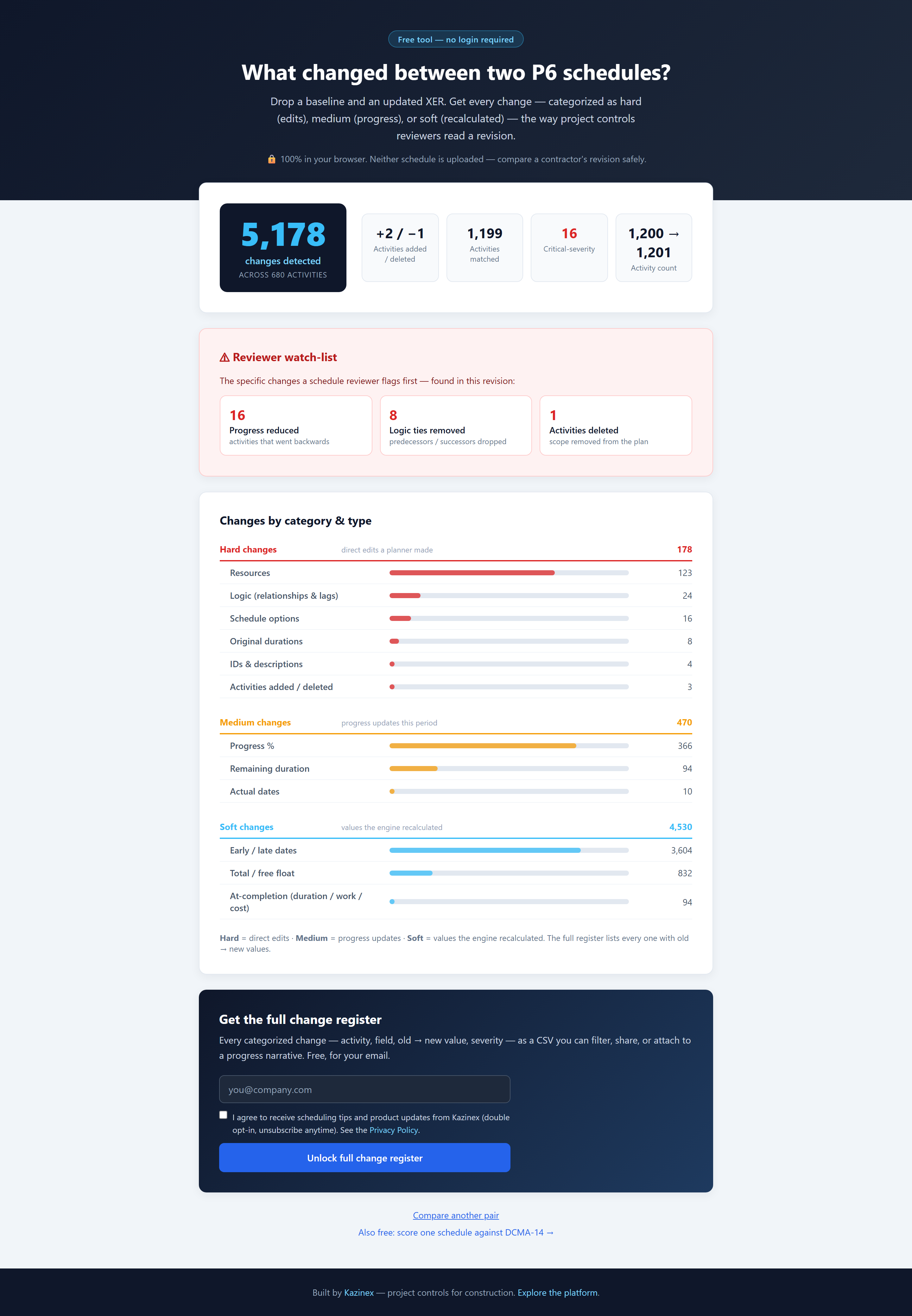
<p>And when you issue a revised programme, use the free <strong><a href="https://schedule.kazinex.com/compare" target="_blank" rel="noopener noreferrer" class="">schedule comparison</a></strong> to produce a clean change register — exactly what reviewers ask for when they want to know what moved and why.</p>
<p><a href="https://schedule.kazinex.com/compare" target="_blank" rel="noopener noreferrer" class=""><img decoding="async" loading="lazy" alt="Kazinex free schedule comparison — what changed between two P6 XERs" src="https://docs.kazinex.com/assets/images/compare-tool-e87d080702b5cecb2ccc3d3ac741a240.png" width="2880" height="4154" class="img_ev3q"></a>
<em>A real weekly update compared in the free <a href="https://schedule.kazinex.com/compare" target="_blank" rel="noopener noreferrer" class="">Kazinex comparison tool</a>: changes categorized as hard (edits), medium (progress), and soft (recalculated), with a reviewer watch-list flagging progress that went backwards and logic ties that were removed.</em></p>
<p><em>Kazinex is built by a team based in the region — the Ramadan-calendar and GCC-owner checks are first-class, not an afterthought. <a href="https://kazinex.com/products" target="_blank" rel="noopener noreferrer" class="">See Kazinex Planner →</a></em></p>]]></content>
        <author>
            <name>Kazinex Team</name>
            <uri>https://kazinex.com</uri>
        </author>
        <category label="gcc" term="gcc"/>
        <category label="schedule-quality" term="schedule-quality"/>
        <category label="primavera-p6" term="primavera-p6"/>
        <category label="dcma" term="dcma"/>
    </entry>
    <entry>
        <title type="html"><![CDATA[The DCMA 14-Point Schedule Check, Explained (With the Thresholds Reviewers Actually Use)]]></title>
        <id>https://docs.kazinex.com/blog/dcma-14-point-schedule-check</id>
        <link href="https://docs.kazinex.com/blog/dcma-14-point-schedule-check"/>
        <updated>2026-07-01T00:00:00.000Z</updated>
        <summary type="html"><![CDATA[What each DCMA 14-point assessment metric means, the pass/fail thresholds, and how to check a Primavera P6 XER against all 14 points in your browser — free.]]></summary>
        <content type="html"><![CDATA[<p>If you submit programmes to a government client, an EPC, or any owner with a real project-controls team, your schedule will sooner or later be scored against the <strong>DCMA 14-point assessment</strong>. Knowing the 14 metrics — and checking them <em>before</em> you submit — is the cheapest credibility you can buy as a planner.</p>
<p>Here's the short version of all 14 points, with the thresholds most reviewers apply.</p>
<p><a href="https://schedule.kazinex.com/quality-check" target="_blank" rel="noopener noreferrer" class=""><img decoding="async" loading="lazy" alt="Kazinex free XER Quality Checker — DCMA-14 score in the browser" src="https://docs.kazinex.com/assets/images/quality-checker-0e5f80a2304025cc5181bef64ce1dbdd.png" width="2880" height="3018" class="img_ev3q"></a>
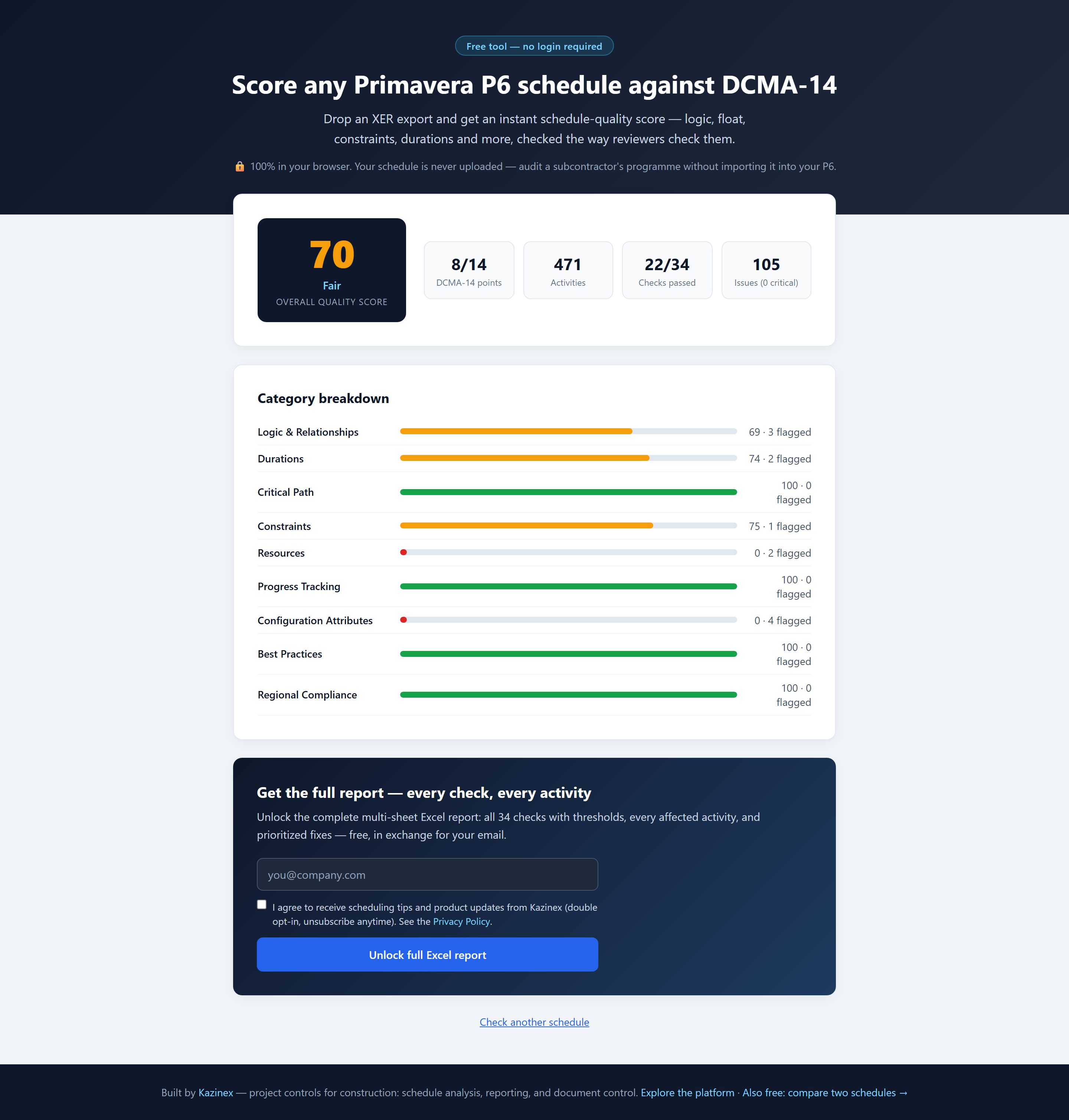
<em>The free <a href="https://schedule.kazinex.com/quality-check" target="_blank" rel="noopener noreferrer" class="">Kazinex XER Quality Checker</a> scoring a real P6 schedule against DCMA-14 — no login, nothing uploaded.</em></p>
<h2 class="anchor anchorTargetStickyNavbar_Vzrq" id="the-14-points-at-a-glance">The 14 points at a glance<a href="https://docs.kazinex.com/blog/dcma-14-point-schedule-check#the-14-points-at-a-glance" class="hash-link" aria-label="Direct link to The 14 points at a glance" title="Direct link to The 14 points at a glance" translate="no">​</a></h2>
<table><thead><tr><th>#</th><th>Metric</th><th>Typical threshold</th></tr></thead><tbody><tr><td>1</td><td><strong>Logic</strong> — activities missing a predecessor or successor</td><td>≤ 5%</td></tr><tr><td>2</td><td><strong>Leads</strong> — negative lags on relationships</td><td>0</td></tr><tr><td>3</td><td><strong>Lags</strong> — relationships with positive lag</td><td>≤ 5%</td></tr><tr><td>4</td><td><strong>Relationship types</strong> — share of FS links</td><td>≥ 90% FS</td></tr><tr><td>5</td><td><strong>Hard constraints</strong> — mandatory start/finish etc.</td><td>≤ 5%</td></tr><tr><td>6</td><td><strong>High float</strong> — total float &gt; 44 working days</td><td>≤ 5%</td></tr><tr><td>7</td><td><strong>Negative float</strong> — total float &lt; 0</td><td>0</td></tr><tr><td>8</td><td><strong>High duration</strong> — remaining duration &gt; 44 working days</td><td>≤ 5%</td></tr><tr><td>9</td><td><strong>Invalid dates</strong> — forecast before / actual after data date</td><td>0</td></tr><tr><td>10</td><td><strong>Resources</strong> — activities without resources/cost (where required)</td><td>0 missing</td></tr><tr><td>11</td><td><strong>Missed activities</strong> — finished later than baseline</td><td>≤ 5%</td></tr><tr><td>12</td><td><strong>Critical path test</strong> — inject delay, confirm the end date moves</td><td>pass</td></tr><tr><td>13</td><td><strong>CPLI</strong> — Critical Path Length Index</td><td>≥ 0.95</td></tr><tr><td>14</td><td><strong>BEI</strong> — Baseline Execution Index</td><td>≥ 0.95</td></tr></tbody></table>
<p>A few of these deserve more attention than they usually get:</p>
<h2 class="anchor anchorTargetStickyNavbar_Vzrq" id="the-ones-that-fail-most-schedules">The ones that fail most schedules<a href="https://docs.kazinex.com/blog/dcma-14-point-schedule-check#the-ones-that-fail-most-schedules" class="hash-link" aria-label="Direct link to The ones that fail most schedules" title="Direct link to The ones that fail most schedules" translate="no">​</a></h2>
<p><strong>Point 1 (Logic).</strong> Open-ended activities are the single most common flag. Every activity except project start/finish should have at least one predecessor and one successor. Missing logic doesn't just fail a checklist — it makes float and the critical path meaningless.</p>
<p><strong>Point 5 (Hard constraints).</strong> <em>Must Finish On</em> and <em>Mandatory Finish</em> constraints override logic. Reviewers read a constraint-heavy schedule as "the dates were typed in, not planned." Prefer soft constraints — or better, logic.</p>
<p><strong>Point 7 (Negative float).</strong> Zero tolerance. Negative float says the plan, as modeled, cannot meet its own commitments. Fix the logic or re-baseline; don't submit it.</p>
<p><strong>Point 12 (Critical path test).</strong> Add a large delay (e.g. 600 days) to a critical activity and reschedule. If the project finish doesn't move by roughly the same amount, your network is broken somewhere — usually by constraints or missing logic.</p>
<h2 class="anchor anchorTargetStickyNavbar_Vzrq" id="check-all-14-points-before-you-submit--free">Check all 14 points before you submit — free<a href="https://docs.kazinex.com/blog/dcma-14-point-schedule-check#check-all-14-points-before-you-submit--free" class="hash-link" aria-label="Direct link to Check all 14 points before you submit — free" title="Direct link to Check all 14 points before you submit — free" translate="no">​</a></h2>
<p>You don't need a P6 license or an Acumen Fuse seat to pre-check a programme. The <strong><a href="https://schedule.kazinex.com/quality-check" target="_blank" rel="noopener noreferrer" class="">Kazinex XER Quality Checker</a></strong> scores any Primavera P6 XER export against DCMA-14 (plus GAO and best-practice checks) <strong>entirely in your browser</strong> — the file is never uploaded, so you can safely check a subcontractor's schedule without importing it into your own P6 environment.</p>
<p>Drop the XER, read the score, fix the flags, then submit.</p>
<p><em>For the full methodology behind each check — thresholds, severities, and how to fix each flag — see the <a class="" href="https://docs.kazinex.com/planner/">schedule quality documentation</a>.</em></p>]]></content>
        <author>
            <name>Kazinex Team</name>
            <uri>https://kazinex.com</uri>
        </author>
        <category label="dcma" term="dcma"/>
        <category label="schedule-quality" term="schedule-quality"/>
        <category label="primavera-p6" term="primavera-p6"/>
    </entry>
    <entry>
        <title type="html"><![CDATA[How to Open and Review an XER File Without Primavera P6]]></title>
        <id>https://docs.kazinex.com/blog/open-xer-file-online-without-p6</id>
        <link href="https://docs.kazinex.com/blog/open-xer-file-online-without-p6"/>
        <updated>2026-07-01T00:00:00.000Z</updated>
        <summary type="html"><![CDATA[Three practical ways to open a .xer file when you don't have a Primavera P6 license — and how to review schedule quality online without uploading the file anywhere.]]></summary>
        <content type="html"><![CDATA[<p>You've been sent a <code>.xer</code> file — a subcontractor's programme, a claim submission, a baseline for review — and you don't have a Primavera P6 license on this machine. What are your options?</p>
<h2 class="anchor anchorTargetStickyNavbar_Vzrq" id="what-a-xer-file-actually-is">What a .xer file actually is<a href="https://docs.kazinex.com/blog/open-xer-file-online-without-p6#what-a-xer-file-actually-is" class="hash-link" aria-label="Direct link to What a .xer file actually is" title="Direct link to What a .xer file actually is" translate="no">​</a></h2>
<p>XER is Primavera P6's plain-text export format: a tab-delimited dump of projects, WBS, activities, relationships, calendars, and resources. Because it's text, lots of tools can <em>read</em> it — the question is how much of the schedule's meaning they preserve (calendars and float are where cheap viewers usually get it wrong).</p>
<h2 class="anchor anchorTargetStickyNavbar_Vzrq" id="option-1-ask-for-a-pdf-or-excel-export">Option 1: Ask for a PDF or Excel export<a href="https://docs.kazinex.com/blog/open-xer-file-online-without-p6#option-1-ask-for-a-pdf-or-excel-export" class="hash-link" aria-label="Direct link to Option 1: Ask for a PDF or Excel export" title="Direct link to Option 1: Ask for a PDF or Excel export" translate="no">​</a></h2>
<p>Fine for a glance, useless for review. You can't trace logic, check float, or verify the critical path in a flattened export. If your job is to <em>approve</em> or <em>contest</em> the schedule, you need the network, not a picture of it.</p>
<h2 class="anchor anchorTargetStickyNavbar_Vzrq" id="option-2-import-it-into-your-own-p6">Option 2: Import it into your own P6<a href="https://docs.kazinex.com/blog/open-xer-file-online-without-p6#option-2-import-it-into-your-own-p6" class="hash-link" aria-label="Direct link to Option 2: Import it into your own P6" title="Direct link to Option 2: Import it into your own P6" translate="no">​</a></h2>
<p>The traditional answer — if you have a license, matching versions, and you're comfortable importing an external contractor's data (with its calendars and global data) into your environment. Many planners keep a scratch database precisely for this. It works, but it's slow, and it's exactly the kind of cross-contamination risk many organizations' P6 admins prohibit.</p>
<h2 class="anchor anchorTargetStickyNavbar_Vzrq" id="option-3-review-it-in-the-browser--without-uploading-it">Option 3: Review it in the browser — without uploading it<a href="https://docs.kazinex.com/blog/open-xer-file-online-without-p6#option-3-review-it-in-the-browser--without-uploading-it" class="hash-link" aria-label="Direct link to Option 3: Review it in the browser — without uploading it" title="Direct link to Option 3: Review it in the browser — without uploading it" translate="no">​</a></h2>
<p>A browser-based analyzer parses the XER locally on your machine. The <strong><a href="https://schedule.kazinex.com/quality-check" target="_blank" rel="noopener noreferrer" class="">Kazinex XER Quality Checker</a></strong> is free and requires no login: drop the file, and it parses the full network client-side — <strong>the schedule never leaves your computer</strong> — then scores it against the DCMA 14-point assessment, flags missing logic, negative float, hard constraints, high-duration activities and more, with an exportable Excel report.</p>
<p>That inversion matters for review workflows: you get a defensible, standards-based read on a contractor's programme <em>before</em> deciding whether it deserves a deeper look in P6 — with no import, no license seat, and no data leaving your laptop.</p>
<p>For ongoing work — editing schedules, comparing baselines, running earned-value and float-path analysis — that's what the full <a href="https://kazinex.com/products" target="_blank" rel="noopener noreferrer" class="">Kazinex Planner</a> is for. But for the "someone emailed me an XER and I need an opinion today" problem, the free checker is the fastest route.</p>
<p><em>Related reading: <a class="" href="https://docs.kazinex.com/blog/dcma-14-point-schedule-check">The DCMA 14-point schedule check, explained</a>.</em></p>]]></content>
        <author>
            <name>Kazinex Team</name>
            <uri>https://kazinex.com</uri>
        </author>
        <category label="xer" term="xer"/>
        <category label="primavera-p6" term="primavera-p6"/>
        <category label="schedule-review" term="schedule-review"/>
    </entry>
</feed>