Pre-Checking a Programme for GCC Owners (Aramco SAEP, Ashghal, and Ramadan Calendars)
Schedules submitted to major Gulf owners — Saudi Aramco, Qatar's Ashghal, and the big regional PMCs — get scrutinized hard. Programme reviewers in the GCC lean on the same schedule-quality fundamentals as DCMA, plus a few regional realities that catch out planners who bring a "template" schedule from elsewhere.
Here's what to check before you submit.
The universal fundamentals still apply
Whatever the owner's specific procedure, the structural basics are non-negotiable, and they map directly onto the DCMA 14-point check:
- No open-ended activities — every task needs a predecessor and successor.
- No negative float — a plan that can't meet its own dates fails on sight.
- Minimal hard constraints — constraint-heavy schedules read as "typed, not planned."
- Logic-driven, not date-driven — the network should compute the dates.
If a schedule fails these, no amount of regional polish saves it. Run it through a DCMA-style check first.
The GCC-specific realities
The Ramadan calendar trap. This is the single most common regional miss. Reduced working hours during Ramadan must be modelled in the P6 calendars, not fudged with constraints or manual date pushes. A schedule that ignores Ramadan will overstate progress and understate durations across every year of the programme — and a sharp reviewer spots it immediately. Build the calendar correctly and let the logic flow through it.
Weekend and holiday conventions. Fri/Sat vs Sat/Sun weekends, plus national holidays (National Day, Eid) that differ by country, all belong in calendars — and they must be consistent across the whole schedule, not per-activity ad hoc.
Owner-specific submission procedures. Aramco's SAEP-series and equivalents at other owners specify how programmes are structured, coded, and progressed. Align WBS, activity coding, and progress conventions to the owner's procedure before submission — retrofitting later is painful.
Pre-check it in the browser first
Before you send a programme to a GCC owner, run it through the free Kazinex XER Quality Checker — it scores the schedule against DCMA-14 and flags missing logic, negative float, hard constraints, and high-duration activities, entirely in your browser (nothing uploaded, which matters when the programme is commercially sensitive).
And when you issue a revised programme, use the free schedule comparison to produce a clean change register — exactly what reviewers ask for when they want to know what moved and why.
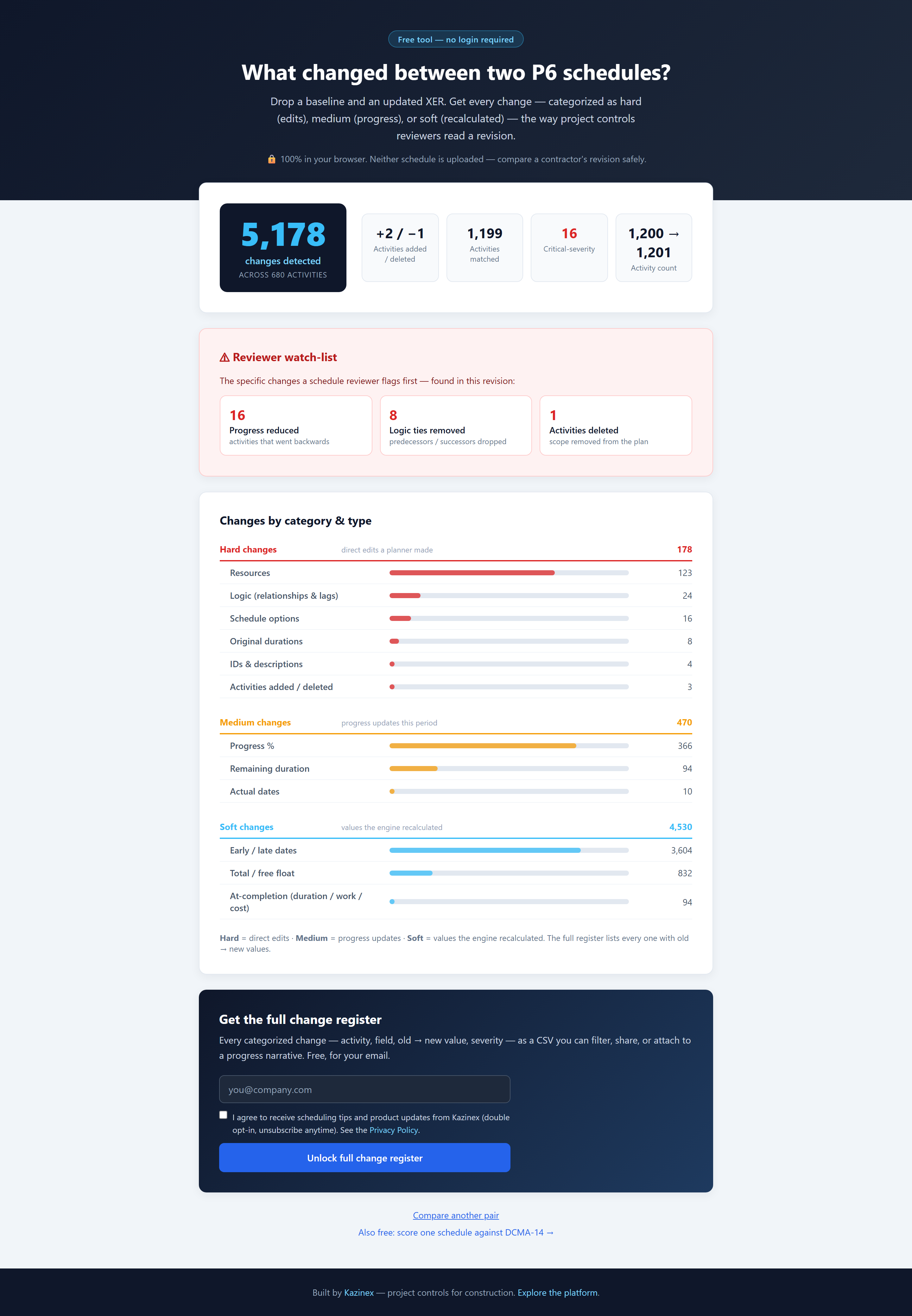 A real weekly update compared in the free Kazinex comparison tool: changes categorized as hard (edits), medium (progress), and soft (recalculated), with a reviewer watch-list flagging progress that went backwards and logic ties that were removed.
Kazinex is built by a team based in the region — the Ramadan-calendar and GCC-owner checks are first-class, not an afterthought. See Kazinex Planner →