The DCMA 14-Point Schedule Check, Explained (With the Thresholds Reviewers Actually Use)
If you submit programmes to a government client, an EPC, or any owner with a real project-controls team, your schedule will sooner or later be scored against the DCMA 14-point assessment. Knowing the 14 metrics — and checking them before you submit — is the cheapest credibility you can buy as a planner.
Here's the short version of all 14 points, with the thresholds most reviewers apply.
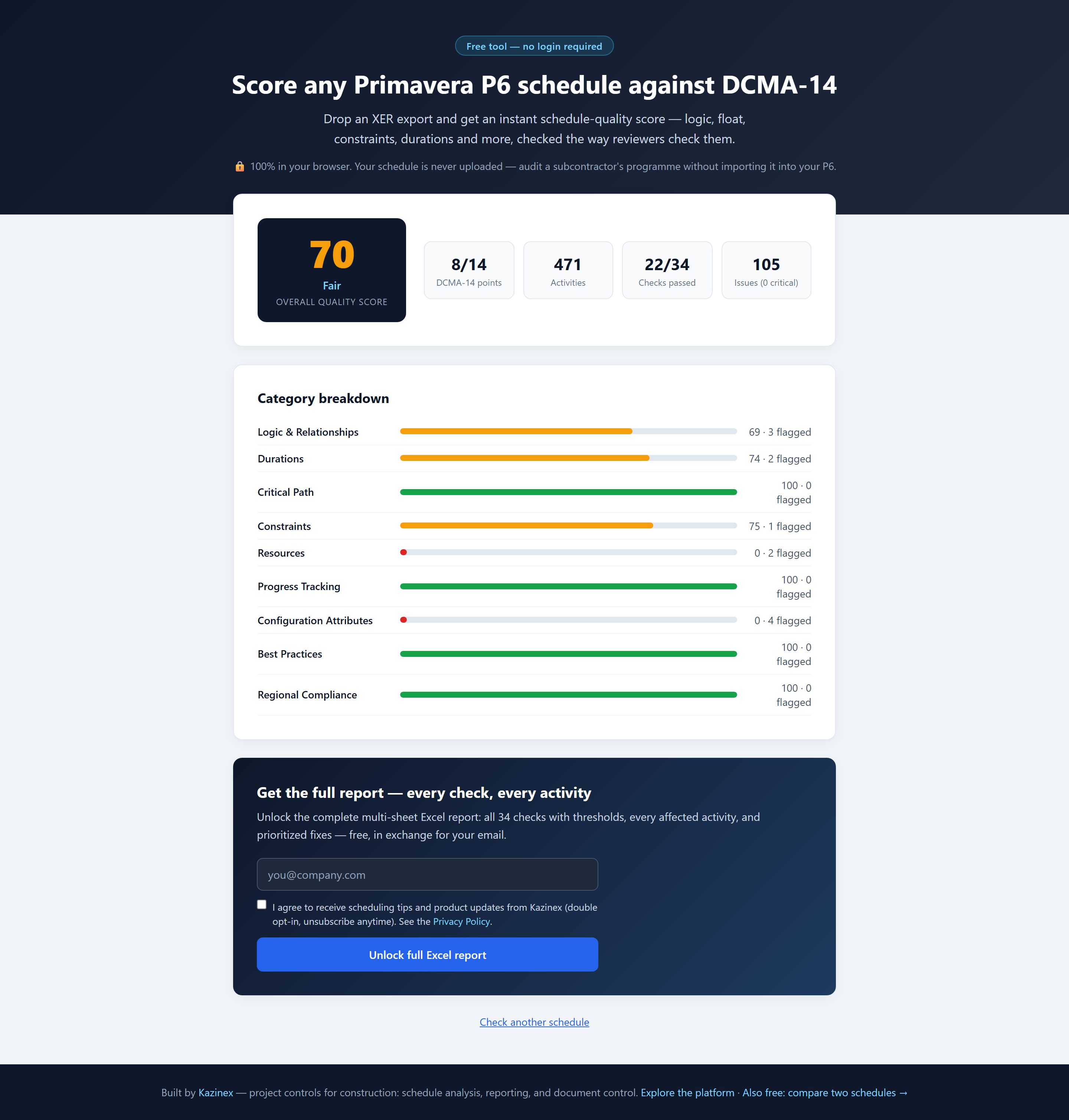 The free Kazinex XER Quality Checker scoring a real P6 schedule against DCMA-14 — no login, nothing uploaded.
The 14 points at a glance
| # | Metric | Typical threshold |
|---|---|---|
| 1 | Logic — activities missing a predecessor or successor | ≤ 5% |
| 2 | Leads — negative lags on relationships | 0 |
| 3 | Lags — relationships with positive lag | ≤ 5% |
| 4 | Relationship types — share of FS links | ≥ 90% FS |
| 5 | Hard constraints — mandatory start/finish etc. | ≤ 5% |
| 6 | High float — total float > 44 working days | ≤ 5% |
| 7 | Negative float — total float < 0 | 0 |
| 8 | High duration — remaining duration > 44 working days | ≤ 5% |
| 9 | Invalid dates — forecast before / actual after data date | 0 |
| 10 | Resources — activities without resources/cost (where required) | 0 missing |
| 11 | Missed activities — finished later than baseline | ≤ 5% |
| 12 | Critical path test — inject delay, confirm the end date moves | pass |
| 13 | CPLI — Critical Path Length Index | ≥ 0.95 |
| 14 | BEI — Baseline Execution Index | ≥ 0.95 |
A few of these deserve more attention than they usually get:
The ones that fail most schedules
Point 1 (Logic). Open-ended activities are the single most common flag. Every activity except project start/finish should have at least one predecessor and one successor. Missing logic doesn't just fail a checklist — it makes float and the critical path meaningless.
Point 5 (Hard constraints). Must Finish On and Mandatory Finish constraints override logic. Reviewers read a constraint-heavy schedule as "the dates were typed in, not planned." Prefer soft constraints — or better, logic.
Point 7 (Negative float). Zero tolerance. Negative float says the plan, as modeled, cannot meet its own commitments. Fix the logic or re-baseline; don't submit it.
Point 12 (Critical path test). Add a large delay (e.g. 600 days) to a critical activity and reschedule. If the project finish doesn't move by roughly the same amount, your network is broken somewhere — usually by constraints or missing logic.
Check all 14 points before you submit — free
You don't need a P6 license or an Acumen Fuse seat to pre-check a programme. The Kazinex XER Quality Checker scores any Primavera P6 XER export against DCMA-14 (plus GAO and best-practice checks) entirely in your browser — the file is never uploaded, so you can safely check a subcontractor's schedule without importing it into your own P6 environment.
Drop the XER, read the score, fix the flags, then submit.
For the full methodology behind each check — thresholds, severities, and how to fix each flag — see the schedule quality documentation.